

Blogs
📋 Table of Contents
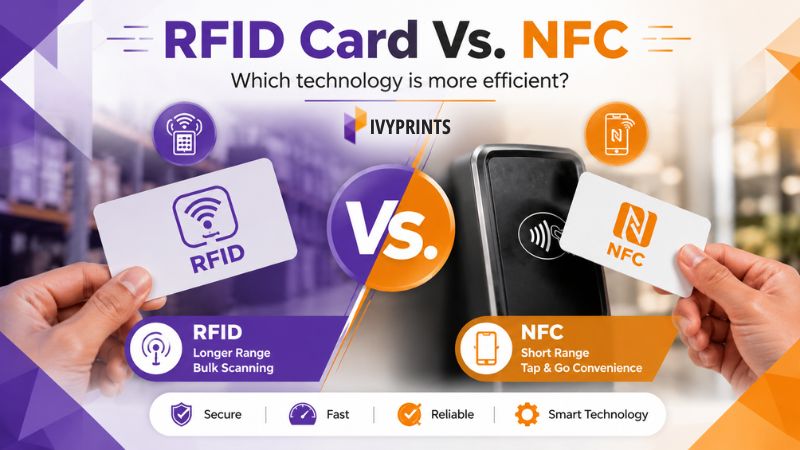
RFID Card Vs. NFC: Which technology is more efficient
14 Jul, 2026
The identification system has gone through a drastic change, shifting towards digitalization and automation. You have seen that now modern buildings don't require showing of physical cards for accessing buildings, restricted areas and verifying identity. Today, that entire landscape has shifted toward wireless, contactless, and automated systems — and two technologies sit at the very heart of this transformation: RFID and NFC.
Buyers often get confused by assuming RFID and NFC both are similar technologies, as both use radio waves. But these are not the same, both differ from each other in terms of range, speed, security and cost.
In this article we’ll provide you with a clear difference between NFC Card (Near Field Communication) and RFID(Radio-Frequency Identification) technology helping you to make informed decisions as per your organization requirements.
What is RFID?
RFID stands for Radio Frequency Identification, which is a popular choice for identity cards because it enables contactless access and secure data storage. RFID is a wireless technology that uses radio waves to transmit data between an RFID card and RFID reader.
The system works in a unique manner: the RFID reader transmits an electromagnetic signal, which is received by the RFID Card.The card then sends back its stored data to the reader. The reader receives the data and sends it to the backend system. This system verifies the data and provides access, logs an entry or performs other relevant actions
What is NFC?
In the field of contactless communication, NFC is also popular but it is often matched with RFID, but both are not the same. It also uses radio waves to transfer data but differ in range, scale, functionality and application from RFID.
It is a short range communication technology that enables two devices to exchange data in close proximity. It is a two way communication (card and compatible reader) that can send and receive information instantly.
Core Difference between RFID and NFC
|
Features |
RFID |
NFC |
|
Range |
It is wider range, upto 100 meter+ |
NFC works at a very shorter range, typically between 0 to 10 cm |
|
Communication Direction |
It is single-sided. |
It is two-way communication. |
|
Reading speed |
RFID can read hundreds of tags simultaneously. |
One device at one time. |
|
Power requirements |
Passive or battery-free |
Relies on powered devices like mobile |
|
Cost |
Lower |
Higher than RFID because they produce two-way communication. |
|
Line of sight needed |
No |
No |
|
Common Frequency |
Comes in different types of Frequencies like 125kHz,(Low) 13.56MHz(High), 860-960MHz (Ultra High) |
13.56MHz is standard Frequency of NFC cards. |
|
Device Compatibility |
Require dedicated Reader |
Built for smartphones |
|
Typical Use Cases |
Inventory management, tracking, access control etc. |
Payments, Ticketing, identity verification. |
|
Security Models |
Relies on encryption. |
Relies on proximity. |
Which Technology is more efficient? Based on Use Cases
Neither technology is "more efficient" — the right choice depends entirely on what you're trying to accomplish.
RFID is more efficient
when speed and scale matter most. A single reader can read hundreds of tags simultaneously making it a good option for large corporations, educational institutions and events. RFID is a clear winner for warehouse inventory counts, retail stock audits and for check-ins as here the single tap and go system is not practical. Also its wide range area is more beneficial than NFC's few centimeters range. Also, passive RFID tags are battery-free making them a cost-effective option.
NFC is more efficient
When security and interactivity matter more. NFC supports faster identification, cashless payments, and smart access control. Its short range reduces the risk of unauthorized remote scanning. NFC also allows two-way communication, ensuring data is written, updated, or exchanged in real time rather than just read. Unlike RFID, which needs a dedicated reader, NFC works with just a smartphone. Its intuitive “tap and go” makes it a popular choice.
Benefits of RFID
- Fast, reads hundreds of tags simultaneously.
- Wide area Range.
- No battery required in passive tags making them pocket friendly.
- Scales well for large inventories.
Benefits OF NFC
- Supports two-way communication.
- Ensure security, buy in short range.
- Easy integration in smartphones.
- Ideal for contactless payments
FAQs
Q.1 Which technology is better for access control — RFID or NFC?
Both are used for access control, and the better choice depends upon need. RFID is more good for bulk scanning, as it can read hundreds of tags simultaneously. While NFC suits close-proximity, secure access scenarios like office doors.
Q.2 Can one card use both technologies?
Yes, modern smart cards can combine both RFID and NFC chips, used in multiple purposes like building access by RFID while payments by NFC.
Q.3 Which technology is cheaper to implement?
Generally passive RFID tags are cheaper, especially in bulk printing, making it a cost-effective option. NFC are slightly expensive because of their added two-way communication capabilities.
Q.4 Will NFC eventually replace RFID?
No, both are used for different purposes it is unlikely that one technology will replace the other one.NFC excels in short range while RFID capabilities are unmatched in long-range.
Conclusion
In conclusion, RFID and NFC both are different technologies, but both offer convenience, security and efficiency. Neither RFID nor NFC is universally “more efficient”; it depends on buyers' requirements what they actually need. RFID is a clear winner in range and scale while NFC is needed when customer comfort matters most-think cashless payments, mobile integration and smart access badges. So, make wise decisions.
Contact IVYPrints today to get highly-tech best quality cards.
✍️ Anushuya Sharma
Anushuya Sharma is a dedicated content writer passionate about crafting compelling narratives that resonate with...
Show More📞 Get In Touch
Have questions? We'd love to hear from you!
✍️ Anushuya Sharma
Anushuya Sharma is a dedicated content writer passionate about crafting compelling narratives that resonate with...
Show More📞 Get In Touch
Have questions? We'd love to hear from you!
Related Blogs
What Are RFID Cards? How They Work and Why They Matter
RFID cards offer fast, secure, and contactless solutions for access, payments, transport, and more in today’s digital world.

Unlocking Access: How RFID Cards Elevate Security in a Connected World
In today's digital age, security is paramount. From protecting confidential data to ensuring seamless access control, modern organizations require innovative solutions. One such advancement is the rise of RFID (Radio Frequency Identification) cards, revolutionizing security paradigms across various industries.

Enhancing Workplace Security with Biometric ID Cards
In an era where the protection of sensitive information is paramount, businesses are constantly seeking innovative solutions to enhance workplace security. One such technology that has gained prominence is the use of Biometric ID Cards. These cards, coupled with advanced features like PVC ID Card Printing in Jaipur and Online services, RFID Card Printing Services, and Custom ID Card Printing Services, are revolutionizing the way organizations safeguard their premises and confidential data.