

Blogs
📋 Table of Contents
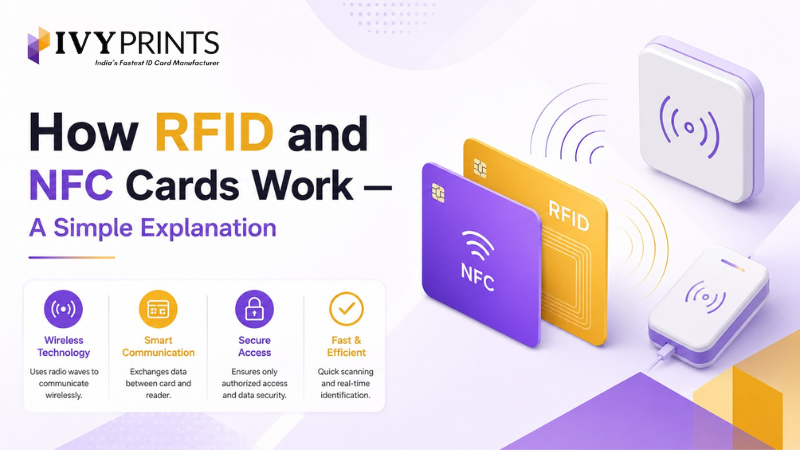
How RFID and NFC Cards Work — A Simple Explanation
02 Sep, 2026
Contactless cards have become part of daily life — badging into an office, tapping to pay, or scanning a membership card at check-in. Behind that simple tap is a well-established radio technology that most people use constantly but rarely think about.
This article breaks down how RFID and NFC actually work, how they differ, and where each is best applied. This will help you to make an informed decision whenever you will invest in smart cards.
The Underlying Principle: Powered by Radio Waves
One of the biggest questions and confusion among buyers is, How do these technologies actually work? They work through electromagnetic induction— a physical principle where a nearby reader generates a radio frequency(RF) field that simultaneously powers the card chip and checks the stored data.
This process happens in four steps including:
- The reader emits a continuous RF field. This acts as a constant signal searching for nearby cards.
- The card's antenna enters that field and connects with incoming radio energy.
- The field powers the chip. The card converts the received radio energy into enough electricity to briefly activate its microchip — no battery needed.
- The chip responds with data. It modulates the field to send back its stored information where data gets checked.
This complete process is very fast, and takes place in milliseconds.
RFID: Built for Range and Volume
RFID (Radio Frequency Identification) is the broader, older technology, originally developed for tracking objects at scale. Its defining strength is range — RFID tags can be read anywhere from a few centimeters to several meters away, depending on the frequency band and whether the tag is passive or active.
Passive RFID tags have no internal power source and completely rely on the reader's field.
Active RFID tags include a small battery, extending their range.
Communication is typically one-directional: the reader queries, and the tag responds. This makes RFID cards efficient for scanning large numbers of tags quickly. Because of this range and speed, RFID is widely used for inventory management, livestock tracking, toll collection, and asset tagging.
NFC: Built for Proximity and Security
In the field of contactless communication, NFC is also popular but it is often matched with RFID, but both are not the same. It also uses radio waves to transfer data but differ in range, scale, functionality and application from RFID.
It is a short range communication technology that enables two devices to exchange data in close proximity. It is a two way communication (card and compatible reader) that can send and receive information instantly. Its short range is intentional. Requiring close proximity significantly reduces the risk of a signal being intercepted or read without the user's knowledge, which is why NFC is the standard for contactless payments, secure building access, and transit systems.
Comparing RFID and NFC
|
Feature |
RFID |
NFC |
|
Range |
Ranges between centimetres to meters |
Short, typically 4 cm |
|
Communication |
One-way |
Two-way |
|
Power Source |
Passive or battery-supported (active) |
Passive |
|
Typical Uses |
Inventory, asset tracking, toll systems |
Payments, access control, smart tags |
|
Security Emphasis |
Protocol- and encryption-based |
Proximity— and encryption– based. |
Why the Distinction Matters
Both work almost in similar manner, so why both are used for different purposes and on what basis which technology we must choose. As choosing between RFID and NFC isn't just a technical footnote — it has real implications for how a card or tag performs in practice:
- Reader range determines whether a card needs to be tapped directly on it or it can be scanned from a distance.
- Generally for security requirements like making payments, restricted access NFC card is chosen because of its shorter, harder-to intercept range.
- Two-way interaction matters for applications like mobile payments or smart tags that need to exchange information with a smartphone, not just broadcast an ID.
- By understanding these differences, organizations can go for chips that best suit their organization.
Card providers like IVYPrints work with both formats regularly, tailoring the chip type to the specific use case rather than defaulting to one technology across the board.
Why RFID and NFC are the future of Identification?
Identification has been a basic necessity since ages, but evolving the way of identification in today’s security-conscious world became more important. To fulfill this demand, smart cards powered by RFID and NFC technologies have emerged as the most reliable and efficient solution.
These smart cards enable contactless, secure, and instant identification, saving time and effort. These cards are used across various sectors from corporate offices to educational institutions to transportation, healthcare, and government services to enhance efficiency.
The Everyday Result
Every time a card is tapped — to unlock a door, board a train, or pay for coffee — it's the result of an invisible radio field waking up a dormant chip and completing a full exchange of data in a fraction of a second. It's a quiet but well-engineered piece of technology that has become so seamless, most people never stop to think about how it works.
And if you want to invest in high quality RFID or NFC cards you can contact IVYPrints to get highly durable and quality cards and readers.
✍️ Anushuya Sharma
Anushuya Sharma is a dedicated content writer passionate about crafting compelling narratives that resonate with...
Show More📞 Get In Touch
Have questions? We'd love to hear from you!
✍️ Anushuya Sharma
Anushuya Sharma is a dedicated content writer passionate about crafting compelling narratives that resonate with...
Show More📞 Get In Touch
Have questions? We'd love to hear from you!
Related Blogs
RFID Card: Complete Guide to Smart Identification Solutions
Explore RFID card technology, its working process, key benefits, and industry applications. Find the best smart identification solution for secure access.