

Blogs
📋 Table of Contents
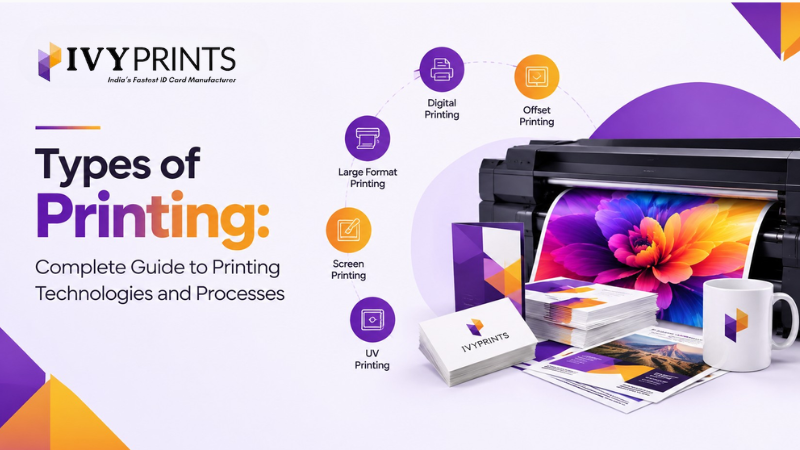
Types of Printing: Complete Guide to Printing Technologies and Processes
14 Sep, 2026
What Is Printing? Definition and Evolution
Printing refers to the process of transferring ink or other materials onto a surface (typically paper or specialty substrates) to create text, images, or designs. From Gutenberg's movable type invention in the 1440s to today's advanced digital technologies, printing has evolved from a manual craft into a sophisticated digital and hybrid process.
Why this matters: Choosing the right printing method can reduce costs by 30-50%, improve quality outcomes, and accelerate project timelines. Whether you're a school administrator managing student ID cards, an HR professional handling employee badges, an event organizer, or a business owner, selecting the appropriate printing technology directly impacts your results.
Why Understanding Printing Technologies Matters
It may appear to be a minor detail, but printing selection is a strategic decision that affects project success, budget, and timeline. A wedding invitation requires entirely different technology than a corporate banner or an employee ID card. Each printing method excels under specific conditions.
Key Decision Factors
Volume requirements: Small batches vs. high-volume production
Substrate type: Paper, plastic, fabric, metal, wood, or glass
Budget constraints: Setup costs vs. per-unit pricing
Quality standards: Image resolution and color consistency needs
Timeline: Quick turnaround vs. longer production windows
Finish requirements: Texture, durability, and special effects
Types of Printing
1. Offset Printing
Definition: Offset printing transfers ink from a printing plate onto a rubber blanket, then onto the final printing surface in a multi-step process. Also called lithography.
Best for: High-volume print runs (10,000+ units), magazines, newspapers, books, and brochures.
Advantages:
Excellent image quality and color consistency
Cost-effective per unit for large quantities
Works on diverse paper stocks and weights
Superior color matching and registration
Disadvantages:
Time-consuming setup and plate preparation
Higher initial setup costs ($500-2,000 per job)
Not suitable for rush projects or short runs
2. Digital Printing
Definition: Digital printing eliminates traditional printing plates by sending files directly from a computer to the printer. Common technologies include laser and inkjet printing.
Best for: Small to medium print runs (1-5,000 units), personalised or variable data printing, quick-turnaround projects.
Advantages:
Rapid production with minimal setup time
Cost-effective for small quantities
Enables variable data printing (personalisation)
No minimum order quantities
Disadvantages:
Per-unit cost higher than offset for large volumes
Color consistency challenges on long runs
Limited substrate options
3. Flexographic Printing (Flexo)
Definition: Flexographic printing wraps flexible relief plates around rotating cylinders to transfer ink onto substrates.
Best for: Packaging materials, labels, plastic bags, pouches, and flexible packaging. Advantages:
Exceptional speed (up to 1,000 feet per minute)
Works on plastic, film, and non-porous surfaces
Extremely cost-efficient for high volumes
Minimal ink waste
Disadvantages:
Less suitable for fine detail work
Requires significant setup investment
Color matching more challenging
4. Gravure Printing
Definition: Gravure printing uses an engraved cylinder where the image is etched into the surface.
Best for: Very high-volume production (1M+ units), photographic content, premium packaging.
Advantages:
Superior print quality with exceptional detail
Ideal for very high-volume production
Highly durable images
Excellent colour depth and tonal range
Disadvantages:
Definition: Digital printing eliminates traditional printing plates by sending files directly from a computer to the printer. Common technologies include laser and inkjet printing.
Best for: Small to medium print runs (1-5,000 units), personalised or variable data printing, quick-turnaround projects.
Advantages:
Rapid production with minimal setup time
Cost-effective for small quantities
Enables variable data printing (personalisation)
No minimum order quantities
Disadvantages:
Per-unit cost higher than offset for large volumes
Color consistency challenges on long runs
Limited substrate options
5. Screen Printing
Definition: Screen printing forces ink through a mesh stencil onto the printing surface.
Best for: Textiles and apparel, posters, signage, and promotional merchandise. Advantages:
Produces exceptionally long-lasting colors
Works on virtually any surface
Perfect for bold designs
Low equipment costs
Disadvantages:
Labor-intensive and slower than digital methods
Best for limited colors (1-4 typically)
Not ideal for photographic detail
6. Letterpress Printing
Definition: Letterpress uses raised type or engraved images that press directly into the substrate, creating a distinctive tactile impression.
Best for: Premium business cards, wedding invitations, limited-edition art prints.
Advantages:
Creates unique, elegant finish
Sophisticated appearance
Highly collectible
Disadvantages:
Significantly slower than modern methods
Higher cost per unit
Not practical for bulk production
7. 3D Printing
Definition: 3D printing builds physical objects layer-by-layer using materials like plastic, resin, or metal.
Best for: Prototyping, architectural models, custom fixtures, low-volume production.
Advantages:
Complex geometries impossible with traditional methods
Rapid prototyping speeds up development
Reduces material waste
No tooling costs
Disadvantages:
Slower for large quantities
Per-unit cost remains high
Post-processing often required
8.ID Card Printing
Definition: ID card printing production uses specialized printing technologies to create secure identification documents.
Card Types:
Standard PVC Cards
Smart Cards (embedded microchips)
RFID Cards (radio frequency identification)
Magnetic Stripe Cards
NFC Cards (near-field communication)
Best for: Schools, corporations, healthcare, events, membership organizations.
Why IVYPrints? Leading Jaipur-based ID card provider specializing in durable, secure identification solutions trusted by thousands of organizations.
9.Thermal Printing
Definition: Thermal printing uses localized heat to produce images on specially coated thermal paper.
Best for: Shipping labels, receipts, barcode labels, ticketing systems.
Advantages:
Extremely fast printing speed
No ink or toner required
Minimal maintenance
Ideal for automated printing
Disadvantages:
Prints fade over time (6-12 months)
Limited to thermal paper
No color capability
10. UV Printing
Definition: UV printing applies ultraviolet light to instantly cure and harden the ink after application.
Best for: Promotional products, non-traditional substrates, high-end packaging.
Advantages:
Instant drying speeds up production
Durability and scratch-resistant finish
Works on acrylic, metal, glass, ceramic
Vibrant colors
Disadvantages:
Higher equipment and operational costs
Requires specialized inks
May require substrate pre-treatment
ComparisonTable
|
Method |
Best Volume |
Cost/Unit |
Quality |
Speed |
Substrates |
|
Offset |
10,000+ |
Low |
Excellent |
Medium |
Paper |
|
Digital |
1-5,000 |
Medium-High |
Good |
Fast |
Limited |
|
Flexographic |
50,000+ |
Very Low |
Good |
Very Fast |
Plastic |
|
Gravure |
1M+ |
Low |
Excellent |
Fast |
Diverse |
|
Screen |
100-10K |
Medium |
Excellent |
Medium |
Most |
|
Letterpress |
1-1K |
High |
Premium |
Slow |
Limited |
|
3D |
1-100 |
Very High |
Varies |
Slow |
Various |
|
ID Card |
100-50K |
Medium |
Excellent |
Medium |
PVC |
|
Thermal |
100-100K |
Very Low |
Fair |
Very Fast |
Thermal paper |
|
UV |
100-50K |
High |
Excellent |
Fast |
Non-porous |
How to Choose the Right Printing Method
Step 1: Define Volume Requirements
Large-scale (50,000+): Offset or gravure printing Medium (5,000-50,000): Offset or screen printing Small (1-5,000): Digital printing
Step 2:Evaluate MaterialType
Paper: Offset or digital Plastic: Flexographic or UV Textiles: Screen or digital Specialty: UV printing
Step 3: DetermineBudget
High setup costs: Gravure, 3D printing Moderate: Offset, screen printing Minimal: Digital, thermal
Step 4: AssessTimeline
Fast (1-2 days): Digital, thermal, UV Standard (3-7 days): Offset, screen, ID card Extended (2-4 weeks): Gravure, 3D printing
Step 5: Consider Quality Needs
Premium: Offset, gravure, letterpress Specialized finishes: UV, screen, letterpress Personalization: Digital, ID card, 3D printing
Conclusion
Printing technology selection is a strategic decision impacting project success, budget, and outcomes. Match your method to your requirements:
High volume, tight budget: Offset or flexographic
Small quantities, fast turnaround: Digital
Textiles and apparel: Screen printing
Unique surfaces and finishes: UV printing
Identification and access control: ID card printing
Prototyping and customization: 3D printing
For ID Card Solutions: Contact IVYPrints for expert guidance and professional execution.
✍️ Anushuya Sharma
Anushuya Sharma is a dedicated content writer passionate about crafting compelling narratives that resonate with...
Show More📞 Get In Touch
Have questions? We'd love to hear from you!
✍️ Anushuya Sharma
Anushuya Sharma is a dedicated content writer passionate about crafting compelling narratives that resonate with...
Show More📞 Get In Touch
Have questions? We'd love to hear from you!
Related Blogs

Order ID Card Online from IVYPrints - School ID Card Printing Services
In today’s world, ID cards have become a crucial part of our daily lives, especially for students, teachers, and employees in educational institutions. Whether you need school ID cards, coaching institute ID cards, event badges, or branded lanyards, IVYPrints offers a wide range of printing services to meet your needs. Ordering ID cards online has never been easier, and IVYPrints ensures that you receive your customized ID cards in just 10 days! Let’s dive into the world of school ID card printing, coaching ID card printing, lanyard printing, and much more, with a focus on online ID card ordering!

Membership Card: Features and Benefits for Organizations
In the modern organizational landscape, membership card have become essential tools for enhancing security, streamlining operations, and fostering a sense of community among members. Whether for clubs, associations, gyms, or other organizations, well-designed membership card provide numerous advantages. IVYPrints, based in Jaipur and trusted by top corporations and businesses across India, excels in delivering high-quality membership card that combine functionality with aesthetic appeal. With a reputation for dispatching orders within 24 hours, over 100,000 satisfied customers, and 250+ designed templates, IVYPrints is a leader in the ID card printing industry.

Swift Solutions: IVYPrints Puts Speed and Quality at the Heart of Every PVC Card Delivery
Are you in need of PVC cards that are not only delivered swiftly but also of the highest quality? Look no further than IVYPrints! We're dedicated to providing swift solutions that prioritize both speed and quality in every PVC card delivery. Let's delve into how IVYPrints stands out as your go-to for PVC card needs.