

Blogs
📋 Table of Contents
SCOSTA Card vs RFID Card: Understanding the Difference
25 Aug, 2026
Smart cards have quietly become part of everyday life — from driving licences and vehicle registration certificates to office access badges and metro travel cards. Two terms that come up often, and get confused frequently, are SCOSTA cards and RFID cards. At IVYPrints, we get asked almost daily: "Aren't these the same thing?" The short answer is no. While both fall under the broader umbrella of smart card technology, they differ in standard, application, and how data is read and written. This blog breaks down the differences so you can choose the right card for your project.
What is a SCOSTA Card?
SCOSAT refers Smart Card Operating System for Transport Applications. It developed in India by the National Informatics Centre (NIC) to ensure uniformity in transport related documents like driving licence and registration certificate.
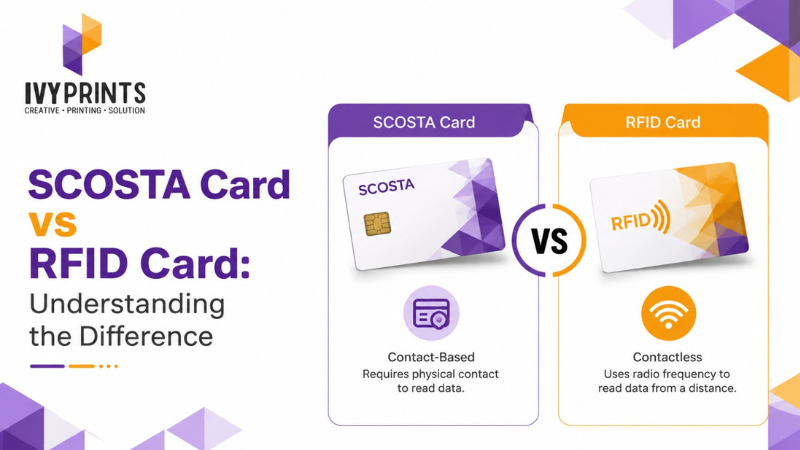
A SCOSTA card is a contact-based chip card, meaning the embedded microchip must physically touch a card reader to transfer data — much like an ATM or credit card with a chip. Government transport data (licence details, vehicle history, biometric data in some states) is sensitive, SCOSTA cards are built with strong data security, tamper resistance, and interoperability across different card readers used by RTOs (Regional Transport Offices) nationwide.
What is an RFID Card?
RFID refers to Radio Frequency Identification, a wireless technology that uses radio waves to transmit information in a contactless manner that makes the whole process smooth, fast, and error-free. RFID technology works uniquely; an RFID reader emits radio signals through its antenna. When an RFID tag enters a nearby area, it transmits its data to the stored system; the information gets checked by the backend system in real-time. You'll find RFID technology in office access badges, hotel key cards, public transit cards, inventory tracking tags, and increasingly in contactless payment cards.
Key Differences: SCOSTA vs RFID
The difference between SCOSTA and RFID cards is following:-
|
Parameter |
SCOSAT Card |
RFID Card |
|
Full Form |
Smart Card Operating System for Transport Applications |
Radio Frequency Identification |
|
Connection Type |
Contact-based (chip touches reader) |
Contactless (wireless, radio waves) |
|
Standard |
ISO/IEC 7816 |
ISO/IEC 14443 / 15693 |
|
Primary Use |
Driving licences, RCs, government transport IDs |
Access control, transit, asset tracking, payments |
|
Governing Body |
NIC / Indian government transport departments |
Global industry standard, multi-sector use like schools, offices. |
|
Read Range |
0 cm (physical contact) |
Few cm to several metres, depending on frequency |
|
Data Security |
High; built for sensitive government data |
Varies by application; generally strong but application-dependent |
|
Speed of Read/write |
Slower due to physical insertion |
Faster, tap-and-go |
Which One Do You Need?
If you're a government body, RTO-linked vendor, or transport department issuing driving licences or RCs in India, SCOSTA compliance is mandatory — this isn't optional, it's a regulatory requirement.
On the other hand, if you're a business looking to issue employee access cards, visitor badges, membership cards, or transit passes, an RFID card is almost always the better fit because of its speed, contactless convenience, and flexibility across use cases.
Some organizations also use hybrid cards that combine both a contact chip (SCOSTA-compliant, where needed) and an RFID antenna — useful when a single card needs to serve multiple purposes, such as a government ID that also doubles as a facility access card.
Some Data Worth Knowing
India's SCOSTA-CL (Contactless) specification was introduced to modernize licence and RC cards while retaining backward compatibility with contact-based readers already deployed at RTOs.
RFID frequency bands commonly used in cards include Low Frequency (125 kHz), High Frequency (13.56 MHz — the most common for access cards), and Ultra High Frequency (860–960 MHz, mainly for logistics and asset tracking).
Contactless (RFID) transactions typically complete in under a second, compared to a few seconds for contact-based chip reads.
Card durability also differs: contactless RFID cards tend to have a longer physical lifespan since there's no repeated physical contact wearing down the chip contacts.
Why This Matters for Card Printing & Issuance
Now, we all know the utmost importance of SCOSAT and RFID cards, but from where to get them, it is not a a small decision, it is a technical decision that requires proper planning as it affects your card printer comparability, reader infrastructure, chip sourcing and software.
IVYPrints a Jaipur-based ID card printing firm work with both SCOSTA-compliant chip cards for government and transport-linked projects, and RFID-based cards for corporate, institutional, and access-control needs. Their cards are of high-quality, services are top-notch and affordable price. Getting this right at the start saves significant rework later, especially when cards need to integrate with existing reader networks. So, choose a reliable provider.
Conclusion
In conclusion, SCOSAT and RFID both are different technologies, SCOSAT is largely used for regulatory contact-based standard built specifically for Indian transport document for security. On the other hand, RFID works as a miracle for offices and schools as it speeds up all works like access control, attendance management and ensures convenience.
Contact IVYPrints to get best quality cards as per your needs.
✍️ Anushuya Sharma
Anushuya Sharma is a dedicated content writer passionate about crafting compelling narratives that resonate with...
Show More📞 Get In Touch
Have questions? We'd love to hear from you!
✍️ Anushuya Sharma
Anushuya Sharma is a dedicated content writer passionate about crafting compelling narratives that resonate with...
Show More📞 Get In Touch
Have questions? We'd love to hear from you!
Related Blogs
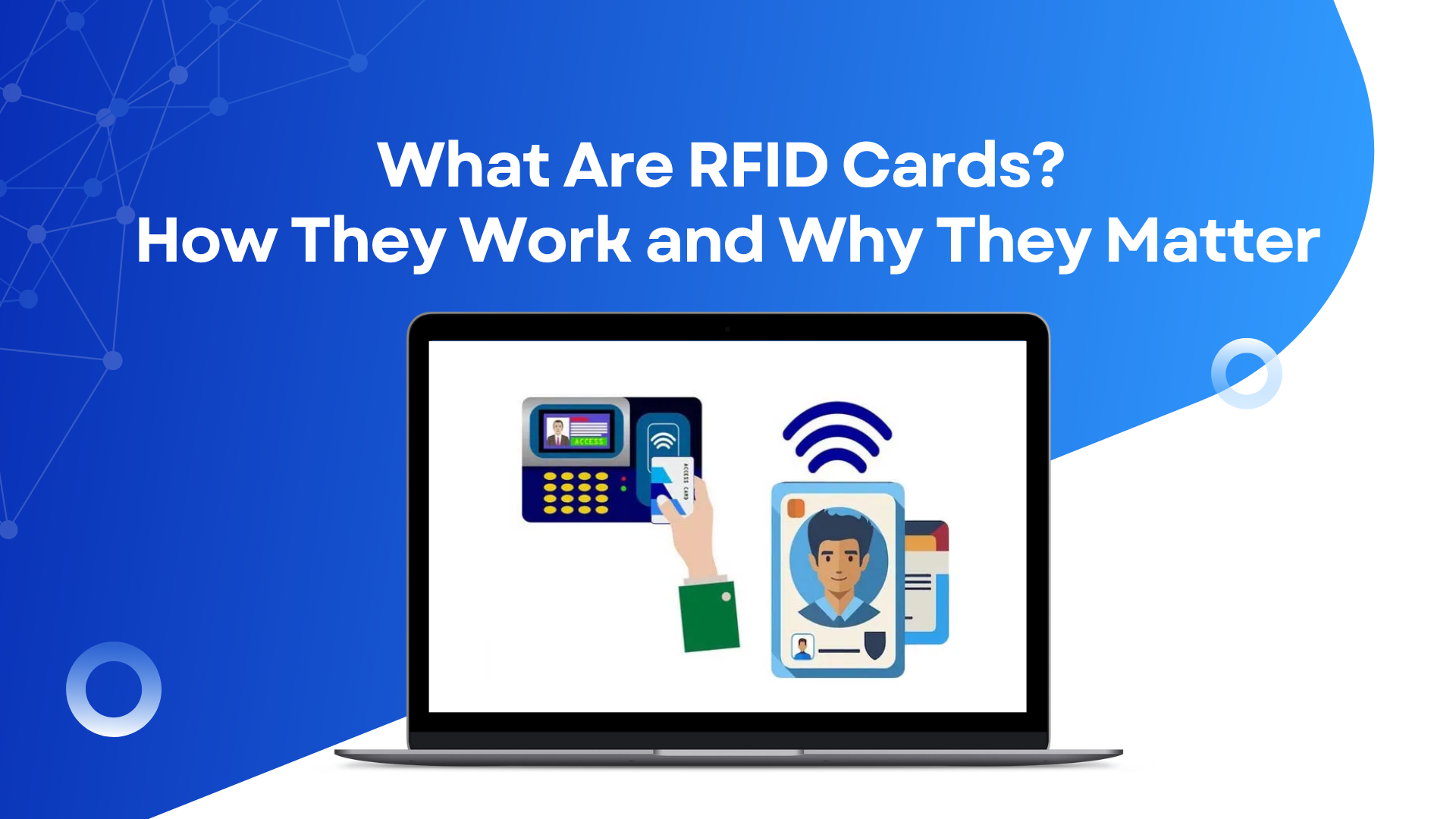
What Are RFID Cards? How They Work and Why They Matter
RFID cards offer fast, secure, and contactless solutions for access, payments, transport, and more in today’s digital world.

Unlocking Access: How RFID Cards Elevate Security in a Connected World
In today's digital age, security is paramount. From protecting confidential data to ensuring seamless access control, modern organizations require innovative solutions. One such advancement is the rise of RFID (Radio Frequency Identification) cards, revolutionizing security paradigms across various industries.

Enhancing Workplace Security with Biometric ID Cards
In an era where the protection of sensitive information is paramount, businesses are constantly seeking innovative solutions to enhance workplace security. One such technology that has gained prominence is the use of Biometric ID Cards. These cards, coupled with advanced features like PVC ID Card Printing in Jaipur and Online services, RFID Card Printing Services, and Custom ID Card Printing Services, are revolutionizing the way organizations safeguard their premises and confidential data.