

Blogs
📋 Table of Contents
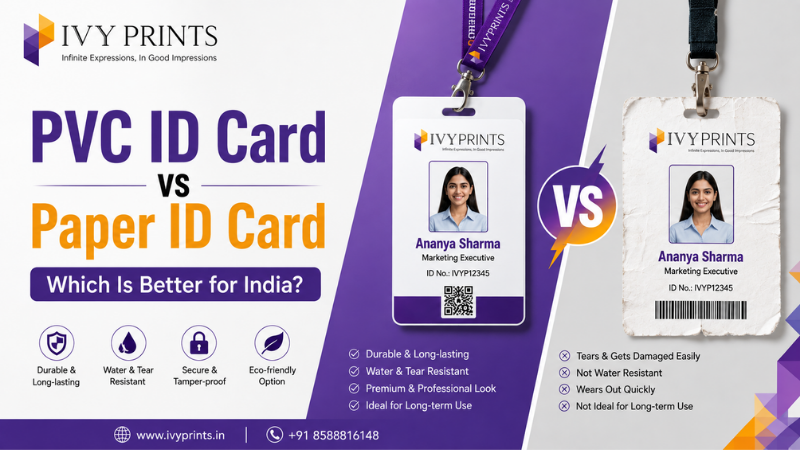
PVC ID Card vs Paper ID Card: Which Is Better for India?
29 Aug, 2026
Walk into any school, office, hospital, or government building in India today, and you'll spot an ID card clipped to almost everyone's shirt or hanging from a lanyard. It's such a normal part of daily life that we rarely stop to ask: what is that card actually made of, and does it matter?
It turns out it matters a lot. The material quality of ID cards affects how long the ID cards last, how professional it looks, how security features are integrated and what its costing. India issues millions of ID cards every year for different departments from schools, colleges, corporates, hospitals and government departments. The decision of choosing the best ID cards is very crucial for every organisation.
In India, the choice is generally made between two common choices i.e. PVC(Polyvinyl Chloride) ID card and Paper ID cards. Both cards fulfill the identification purpose but both vary in other aspects and in this article we’ll break down the real differences so you can make an informed decision for your organization.
What Is a Paper ID Card?
Paper ID card— it is clear by its name that it is made from paper that is often laminated afterwards with a thin plastic pouch for basic protection. These are inexpensive, quick to produce, often used in events, exams, small schools and temporary staff.
What Is a PVC ID Card?
PVC ID cards are plastic cards made of polyvinyl chloride, a thermoplastic resin used for multiple purposes. Nowadays, PVC cards are one of the main ID cards for organisations and schools because they are durable, attractive, and cost-effective. Typically measures the standard size CR80. These cards are easily customizable with personalised information such as logo, name, photo, designation and security features.
Head-to-Head Comparison
Durability
Paper cards, even laminated ones, wear out fast — corners fray, lamination peels, and the card becomes unreadable within months. PVC cards can survive years of daily handling, bending, and even accidental water exposure without falling apart.
Professional Appearance
A PVC card has the sturdy, premium feel of a bank card. It signals credibility, whether it's for a corporate employee, a college student, or a government scheme beneficiary. Paper cards, however well-designed, tend to look temporary and low-cost.
Security Features
This is where PVC pulls far ahead. It supports holographic overlays, embedded chips, barcodes, QR codes, and tamper-evident finishes — all of which are difficult to fake. Paper cards offer little to no protection against duplication or forgery, making them risky for anything requiring identity verification.
Cost
Paper cards are cheaper upfront, which is why they're still popular for one-day events, exhibitions, or short-term visitor passes. PVC cards cost more per unit but last so much longer that the cost-per-year is usually lower for any card used regularly.
Weather and Handling Resistance
India's climate is tough on paper — humidity, monsoon dampness, and heat all degrade paper cards quickly. PVC is naturally water-resistant and holds up well across seasons and regions.
Reprinting and Replacement Costs
Because paper cards degrade faster, organizations end up reprinting them repeatedly, which adds up in both cost and administrative effort. PVC cards need far less frequent replacement.
Environmental Considerations
Paper is often assumed to be "greener," but once laminated in a plastic ID card, it becomes a hybrid that's hard to recycle either way. PVC's longer lifespan means fewer cards are produced and discarded overall, which can offset its plastic footprint compared to repeatedly reprinting paper cards.
So, Which One Should You Choose?
Go with paper ID cards if:
- You need a temporary card for a one-day event, seminar, or short visit
- Budget is extremely tight and the card will be discarded soon after
- Security and durability aren't a priority
Go with PVC ID cards if:
- The card will be used daily for months or years (employees, students, members)
- You need built-in security like barcodes, QR codes, or chips
- You want a professional, trustworthy appearance
- You're building any kind of long-term access or identification system
For the vast majority of Indian schools, colleges, hospitals, corporates, and government programs, PVC is the clear winner. The slightly higher upfront cost pays for itself many times over in durability, security, and brand image.
Getting Your PVC ID Cards Made Right
Finalizing PVC cards is half the job– now you have to look for a reliable provider that can give you high-quality customized ID cards that stand strong against fading, cracking and weather conditions and an experienced printing partner can make a lot of difference.
IVYPrints is such a provider, its reliability makes it nationwide popular as it specialises in offering crisp, photo-quality printing, advanced security features and durable raw material.
If you are looking for a bulk ID card provider for an entire institution, nothing can suit you more than IVYPrints as it combines fast turnaround with reliable, long-lasting results.
Conclusion
In conclusion, the right ultimately depends on the institutional needs. Both types of cards fulfill the main function of ID cards, that is identification but the difference lies in different aspects like durability, longevity, resistance and security requirements. If you want an ID card for a day like for an event, a Paper card can work well, but if you want to make an investment for years along with security features, PVC cards can best suit you.
Contact IVYPrints to get high-quality best PVC or paper cards.
✍️ Anushuya Sharma
Anushuya Sharma is a dedicated content writer passionate about crafting compelling narratives that resonate with...
Show More📞 Get In Touch
Have questions? We'd love to hear from you!
✍️ Anushuya Sharma
Anushuya Sharma is a dedicated content writer passionate about crafting compelling narratives that resonate with...
Show More📞 Get In Touch
Have questions? We'd love to hear from you!
Related Blogs

Common Mistakes to Avoid in PVC Card Design: Ensure Your Cards Make the Right Impression
PVC cards have become an essential part of modern life, serving as ID cards, membership cards, loyalty cards, and much more. They offer a durable, secure, and versatile way to carry important information and represent your brand. But with great power comes great responsibility (and yes, even in PVC card design!). To ensure your cards are effective, professional, and leave a lasting positive impression, it's crucial to steer clear of common design pitfalls.

Comparing PVC ID Card Materials for Durability: Choosing the Right Fit for Your Needs
When it comes to PVC ID Card Printing Jaipur, durability matters. After all, these cards serve as identification, access control, and even brand representatives. But with a variety of PVC Card Printing India material options available, choosing the right one can be confusing. Here, we break down the most common choices to help you select the most durable RFID Card Printing Services solution for your specific needs.

The Green Advantage: Eco-Friendly PVC Cards
In the bustling city of Jaipur, where tradition meets technology, the demand for PVC ID card printing has skyrocketed. Businesses and organizations are on the lookout for efficient and eco-friendly solutions to meet their identification needs. At Ivy Prints, we understand the pulse of the market, providing top-notch PVC card printing services in Jaipur, India. Our commitment extends beyond just delivering PVC cards; we embrace the green advantage, ensuring that our products are environmentally responsible without compromising quality.