

Blogs
📋 Table of Contents
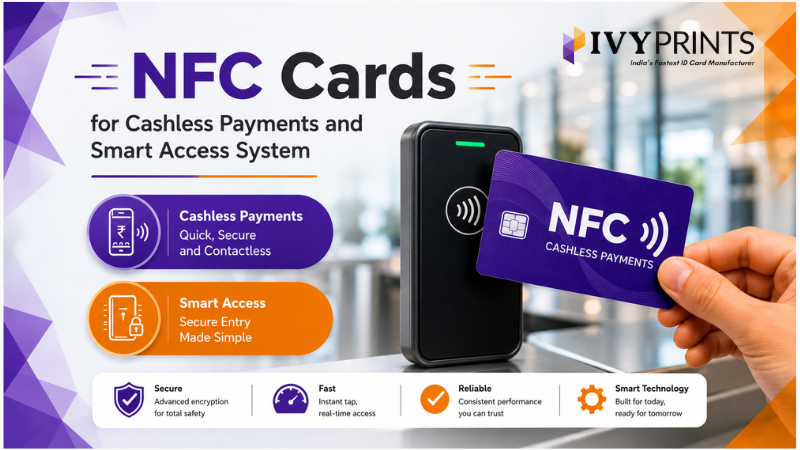
NFC Cards for Cashless Payments and Smart Access System
30 Jul, 2026
We all know, smart cards have revolutionized the way we live our everyday life. Now, there is no need to carry cash, remember PINs, or carry bulky keychains for access and making payment. All this has become simplified just by one small but mighty piece of technology:- NFC(Near Field Communication) cards. The things which seem unreal or futuristic have become one of the basic necessities nowadays. Educational Institutions, Offices, Public Transport, Gyms all rely on NFC cards for security and efficiency. So, in this article we’ll know everything about NFC cards, their usage, provider and the reasons why it has become a catalyst of change.
What Is an NFC Card?
NFC stands for Near Field Communication which often looks similar to RFID Card technology. But both are different, NFC is a smart card embedded with a tiny chip and antenna that communicates wirelessly with compatible readers over a short range(Generally under 4 cm). NFC cards only need tapping on the compatible reader to verify identity, get access and make payment
This same technology powers contactless bank cards, metro cards, hotel key cards, and employee ID badges — all built on a standard that prioritizes speed and security.
Why NFC Cards Are Growing So Fast
There is no need to praise NFC technology, because the recent data has proved how efficient this technology is. The global NFC market was on track to surpass roughly $37–40 billion by 2026, driven largely by contactless payments and smart access adoption. Contactless transactions now account for close to 79% of daily consumer purchases in many markets, and NFC-enabled devices are present in over 78% of smartphones worldwide. Also, on the access control side, NFC technology has given a boost to the hardware market by large purchases of NFC tags and readers.
This growth isn't accidental, it is necessary. NFC card do following:-
Speed: With NFC large queues has come to an end, now the transaction and entry is done within a second.
Hygiene and convenience: After Covid-19 physical contact has become less common and in NFC cards there is no need for physical contact.
Security: Data is highly encrypted making NFC cards harder to clone than magnetic stripe cards.
Cost efficiency: Businesses save on cash-handling costs, key replacement, and manual access logs.
Sustainability: NFC cards are highly durable cards that can be effective for years with no paper waste resulting in sustainability.
NFC Cards in Cashless Payment Systems
NFC Cards have given birth to tap to pay culture, a single tap can make payments at retail shops, cafeterias, and even to street vendors. Customers simply have to put their card, phone or wearable at the reader and the transaction is verified and completed on the spot.
NFC payment cards are used in:
- Corporate cafeterias and vending machines.
- Campus meal cards for schools and universities.
- Prepaid transit and parking cards.
- Loyalty and gift cards with tap-to-redeem functionality.
NFC Cards in Smart Access Systems.
On the other hand, on the access control side, NFC cards have sidelined the traditional cards. NFC cards carry a unique, encrypted identifier that a smart reader verifies in real time, granting or denying entry.
Smart access NFC cards also enable:
- Time-based access restrictions (e.g., office hours only).
- Instant deactivation of lost or stolen cards.
- Integration with attendance and visitor management systems.
- Multi-purpose use — the same card can fulfill the purpose of ID badge, canteen payment
card, and door key
Custom NFC Cards with IVYPrints
Knowing the endless benefits of NFC cards, it became necessary to invest in these modern cards. But where to get? In the plethora of printing providers buyers found themselves confused. But among the trusted names, IVYPrints have a significant reputation, as they specialize in customized NFC, RFID and Barcode cards. IVYPrints is different from other providers because they use advanced printing technology to deliver vibrant, durable, and high-resolution smart ID cards. Their affordable prices make it easy for small schools, retail shops to adopt smart identification solutions without overspending.
They made cards from premium-grade raw materials that are resistant to wear, tear, and fading-ensuring long-lasting performance.
Choosing the Right NFC Card for Your Business
You must know the reason why you are shifting to answer technology, by adopting NFC businesses to simplify the whole process. But while investing consider:-
- Use case — payments, access control, or both (hybrid cards are increasingly common).
- Chip type and encryption standard — ensures compatibility with existing readers.
- Card durability — PVC, composite, or
eco-friendly materials depending on usage frequency.
- Branding needs — custom printing, holograms, or QR-NFC hybrid designs
- Vendor support — reliable printing partners like IVYPrints simplify rollout and reordering
FAQs
Q1: How is an NFC card different from an RFID card?
NFC is a short range communication technology that supports two way communication making it a more secure option for making payment and access control. While RFID is more about quick identification that doesn't support two-way communication.
Q.2 Which technology is better for access control — RFID or NFC?
Both are used for access control, and the better choice depends upon need. RFID is more good for bulk scanning, as it can read hundreds of tags simultaneously. While NFC suits close-proximity, secure access scenarios like office doors.
Q3: What is the cost of NFC cards?
The cost of NFC cards depends upon your requirements, it may cost slightly higher than simple PVC cards, but their life-span is long best for institutions who want relief from continuous reordering.
Q4: Do NFC cards need a battery or internet connection?
No. Standard NFC cards are passive — they draw power from the reader's electromagnetic field during a tap and don't need batteries, Wi-Fi, or cellular data to function.
Conclusion
In conclusion, NFC technology has revolutionized the years old tradition of carrying cash and a large number of keys or cards. Now, everything is possible with one single NFC card. These cards are wonderful for secure payments procedure and access control. For schools, businesses, govt. agencies, Public Transport and retail shops investing in NFC cards can be the best decision leading one step ahead in digitalization.
✍️ Anushuya Sharma
Anushuya Sharma is a dedicated content writer passionate about crafting compelling narratives that resonate with...
Show More📞 Get In Touch
Have questions? We'd love to hear from you!
✍️ Anushuya Sharma
Anushuya Sharma is a dedicated content writer passionate about crafting compelling narratives that resonate with...
Show More📞 Get In Touch
Have questions? We'd love to hear from you!
Related Blogs